Paying for university or TVET college can be one of the biggest challenges students face in South Africa.
Tuition fees, accommodation, textbooks, and daily living costs quickly add up. For many students, bursaries are the most effective way to cover these expenses without accumulating debt.
A bursary is financial support provided by a company, government department, foundation, or organization to help students complete their studies.
Unlike student loans, bursaries usually do not need to be repaid. In many cases, the only requirement is that students maintain good academic performance or work for the sponsoring organization after graduation.
If you are planning to study in 2027, this guide will help you understand how bursaries work, who qualifies, and how to apply successfully.
Many students miss opportunities simply because they start too late or apply incorrectly. Preparing early gives you a major advantage.
Before exploring the list of bursaries available across South Africa, it is important to understand the basic requirements and application process.
Who Qualifies for a Bursary in South Africa?
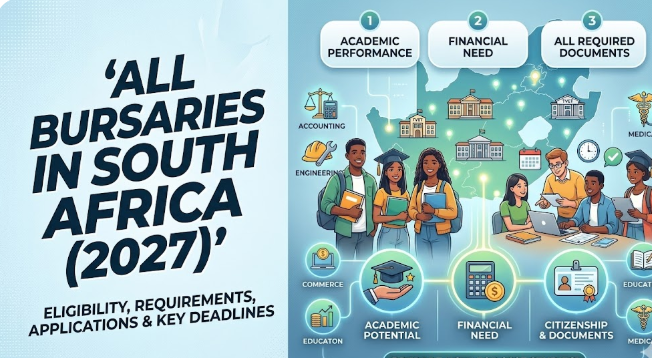
Most bursary providers look for two key factors: academic potential and financial need.
Although requirements vary depending on the sponsor, most bursaries require applicants to meet the following conditions:
• You must be a South African citizen or permanent resident
• You must currently be in Matric or have already completed Matric
• You must be planning to study full-time at a recognized university, university of technology, or TVET college
• You must demonstrate financial need, usually through proof of household income
• You must have strong academic results, especially in key subjects related to your chosen field
Some highly competitive bursaries may also require leadership experience, community involvement, or participation in extracurricular activities.
Students who meet these requirements should start preparing applications as early as possible, especially if they plan to begin their studies in 2027.
Documents You Must Prepare Before Applying
A large percentage of bursary applications are rejected simply because students fail to submit the required documents.
Preparing these documents early will help you apply faster and avoid missing deadlines.
Most bursaries require the following certified documents:
• Certified copy of your South African ID document
• Certified copy of your latest academic results (Matric results or current university transcripts)
• Proof that you have applied to or been accepted by a tertiary institution
• A motivational letter explaining why you deserve the bursary
• Proof of household income for parents or guardians (payslips, affidavits, or proof of unemployment)
Some bursaries may also request reference letters, a CV, or additional academic documents.
Keeping both digital copies and certified physical copies of these documents will make your applications easier.
How to Write a Strong Motivational Letter for a Bursary
Your motivational letter is one of the most important parts of your application. This is where you explain why you are the right candidate.
A strong motivational letter should include the following elements.
Introduce yourself clearly
Start by stating your name, the qualification you want to study, and the institution where you plan to study.
Explain your financial situation
Briefly explain why you need financial assistance and how the bursary will help you achieve your academic goals.
Share your career motivation
Explain what inspired you to choose your field of study. Personal experiences or community impact stories often make your application stronger.
Demonstrate your long-term goals
Many bursary providers want to support students who will contribute positively to society or the economy after graduation.
If the bursary requires a work-back agreement, confirm that you are willing to work for the organization after completing your studies.
Preparing for a Bursary Interview
Some organizations shortlist candidates and invite them for an interview before awarding funding.
If you receive an interview invitation, it means you are already among the strongest applicants.
To prepare effectively:
Research the bursary provider
Visit the organization’s official website and learn about their mission, values, and industry. Demonstrating knowledge about the company shows genuine interest.
Practice common interview questions
Typical questions include:
• Tell us about yourself
• Why did you choose this field of study?
• What are your career goals?
• What challenges have you overcome?
Practicing your answers in advance will help you speak confidently.
Prepare thoughtful questions
At the end of the interview, ask questions about internship programs, mentorship opportunities, or graduate placements. Avoid asking about allowances or payments during the first interview.
Major Fields With Bursary Opportunities in South Africa
Hundreds of bursaries are available every year across different academic disciplines. Students should focus on opportunities related to their chosen career field.
Below are the major categories where students can find bursaries for the 2027 academic year.
Accounting and Finance Bursaries
Students studying accounting, finance, auditing, or financial management can apply for bursaries offered by leading firms and financial institutions.
Examples include:
• Deloitte Bursary
• PwC Bursary
• KPMG Bursary
• EY Bursary
• SAICA Thuthuka Bursary
• Standard Bank Bursary
• Old Mutual Accounting Bursary
• Auditor-General of South Africa Bursary
These bursaries often cover tuition fees, textbooks, and sometimes accommodation.
Engineering Bursaries
Engineering remains one of the fields with the largest number of bursaries in South Africa.
Students studying civil, mechanical, electrical, mining, chemical, or industrial engineering can apply for funding from companies in the mining, energy, construction, and manufacturing sectors.
Examples include:
• Eskom Bursary
• Transnet Bursary
• Sasol Bursary
• De Beers Bursary
• ArcelorMittal Bursary
• Siemens Bursary
• BMW Bursary
• Huawei Technologies Bursary
• Anglo American Bursary
Many engineering bursaries include vacation work and guaranteed employment after graduation.
Commerce and Business Bursaries
Students studying business administration, economics, marketing, or human resources can access bursaries from financial institutions, consulting firms, and corporate organizations.
Examples include:
• Investec Bursary
• IDC Bursary
• Coronation Exceptional Student Bursary
• Brand South Africa Bursary
• VKB Group Bursary
These bursaries often include internships and graduate development programs.
Computer Science and IT Bursaries
Technology skills are in high demand across South Africa. Many companies sponsor students studying computer science, software development, cybersecurity, or information systems.
Examples include:
• Vodacom Bursary
• MultiChoice Bursary
• Amazon Bursary
• Hewlett Packard Enterprise Bursary
• Cisco Charitable Foundation Trust Bursary
• WeThinkCode Bursary
Many tech bursaries also provide mentorship, internships, and access to industry networks.
Education and Teaching Bursaries
Students who want to become teachers can apply for government-supported education bursaries.
The most well-known program is:
• Funza Lushaka Bursary
This program funds students studying teaching in priority subjects such as mathematics, science, and languages.
Medical and Health Science Bursaries
Students pursuing careers in healthcare can apply for bursaries in fields such as nursing, pharmacy, physiotherapy, and medicine.
Examples include:
• Netcare Bursary
• Mediclinic Bursary
• Life Healthcare Bursary
• South African Medical Association Bursary
• DENOSA Bursary
Healthcare bursaries often require graduates to work in public health facilities after completing their studies.
Government and Municipal Bursaries
Many government departments and municipalities provide bursaries to support students in fields related to public service.
Examples include:
• City of Johannesburg Bursary
• City of Cape Town Bursary
• Department of Water and Sanitation Bursary
• Department of Agriculture Bursary
• Provincial Treasury Bursaries
These programs usually require graduates to work within the government sector for a few years.
Postgraduate Bursaries
Students pursuing Honours, Masters, or PhD programs can apply for postgraduate funding opportunities such as:
• Mandela Rhodes Foundation Scholarship
• Mastercard Foundation Scholarship
• NRF Postgraduate Scholarship
• Oppenheimer Memorial Trust Scholarship
These bursaries often support research and advanced academic work.
Competition for bursaries is high, especially for popular fields such as medicine, engineering, and accounting.
Students can improve their chances by following these strategies:
Apply for multiple bursaries, not just one
Submit applications months before deadlines
Maintain strong academic results
Participate in leadership and community activities
Prepare a clear and convincing motivational letter
Applying early and submitting complete applications significantly increases the likelihood of receiving funding.
Start Preparing for 2027 Bursary Applications Now
If you plan to study in 2027, the best time to begin preparing is now.
Many bursary applications open 6–12 months before the academic year begins, meaning some applications will start opening during 2026.
Students who prepare their documents early, research bursary opportunities, and apply to multiple programs greatly improve their chances of securing funding.
Start by identifying bursaries that match your field of study, gather your certified documents, and prepare a strong motivational letter.
Submitting your applications early and correctly could be the step that secures your university education.