Success in the workplace rarely happens by accident. While companies are responsible for creating supportive environments, employees also play a major role in determining their own career outcomes.
The most successful professionals consistently take ownership of their growth, understand what is expected of them, and actively contribute to the goals of their organization.
What do you think are the three most important things an employee should do to be successful in their job?
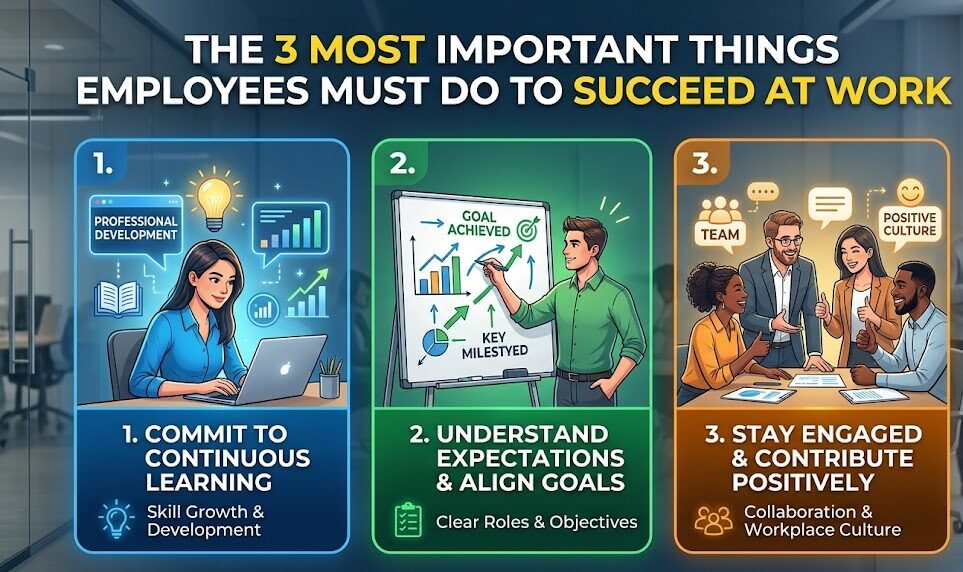
Although many factors influence workplace success, three stand out as the most important: continuous learning, clear alignment with goals and expectations, and strong engagement with the organization and its people.
Employees who master these areas often become the most valuable contributors in any workplace.
1. Commit to Continuous Learning and Skill Development
One of the most important actions an employee can take is investing in their own professional development.
Work environments are constantly evolving due to new technologies, industry changes, and shifting customer expectations. Employees who fail to grow their skills risk falling behind.
Continuous learning allows employees to improve their performance in several ways:
- It strengthens job-related skills and technical competence
- It increases confidence when handling responsibilities
- It prepares employees for promotions and leadership opportunities
Training should not only focus on immediate job requirements. Employees benefit greatly from developing broader capabilities such as communication, leadership, problem-solving, and strategic thinking.
Learning can take many forms, including:
- On-the-job training
- Professional courses and certifications
- Mentorship from experienced colleagues
- Attending conferences or workshops
- Cross-training in different departments
Employees who consistently upgrade their skills often become more productive and more valuable to their organizations.
They also position themselves as future leaders within the company.
2. Understand Expectations and Work Toward Clear Goals
A second key factor in job success is clarity. Employees perform better when they clearly understand what is expected of them and how their work contributes to organizational objectives.
Without clear expectations, even talented employees may struggle to perform well. Confusion about priorities, responsibilities, or performance standards can lead to missed deadlines, poor communication, and reduced productivity.
Successful employees take the initiative to ensure they understand:
- Their specific role and responsibilities
- Key performance goals and deadlines
- How their work contributes to company success
- The standards used to evaluate their performance
They also actively track their progress toward goals and communicate with managers when challenges arise.
Employees who are goal-oriented typically demonstrate several positive behaviors:
- Meeting or exceeding deadlines
- Managing time effectively
- Taking responsibility for results
- Seeking feedback to improve performance
When employees align their efforts with the organization’s priorities, their work becomes more meaningful and impactful.
3. Stay Engaged and Contribute to a Positive Workplace Culture
Engagement plays a major role in workplace success. Engaged employees are emotionally invested in their work and committed to helping their organization succeed.
Research consistently shows that engaged employees are more productive, more innovative, and more likely to remain with their employers long-term. In contrast, disengaged workers often struggle with motivation and performance.
Employees can improve their engagement by taking several proactive steps:
- Building strong relationships with colleagues
- Participating in team collaboration
- Communicating ideas and feedback
- Demonstrating initiative and ownership of tasks
Being a team player is especially important. Organizations value employees who prioritize team goals over individual recognition and who willingly support colleagues when needed.
Engaged employees also maintain a positive attitude, which contributes to a healthier workplace culture. Positivity encourages cooperation, improves morale, and helps teams overcome challenges more effectively.
When employees feel connected to the organization’s mission and understand how their work contributes to larger objectives, they tend to perform at a much higher level.
Why These Three Factors Matter Most
While many strategies can improve workplace performance, continuous learning, clear goals, and strong engagement form the foundation of employee success.
Employees who develop their skills remain competitive in their field. Those who understand expectations can deliver consistent results. And those who stay engaged help create productive, collaborative workplaces.
Together, these three elements help employees grow professionally while also helping organizations achieve their strategic objectives.
Success at work is not just about completing tasks or meeting deadlines. It involves actively developing skills, aligning with organizational goals, and contributing positively to the workplace environment.
Employees who focus on learning, clarity, and engagement often find themselves progressing faster in their careers. They become trusted contributors, valuable team members, and potential future leaders within their organizations.
For anyone aiming to build a successful career, these three habits provide a reliable foundation for long-term professional growth.